

Hydraulic C-frame press buyer's guide: types, tonnage & how to choose the right model
Release time:
Sep 22,2026
Complete 2026 buyer's guide to hydraulic C-frame presses: compare tonnage options (10–100 ton), C-frame vs H-frame vs 4-column, safety standards (OSHA/ANSI B11.2), total cost of ownership, and real-world use cases for automotive, fabrication, and aerospace shops.
Article overview
This guide covers the complete purchase decision for a hydraulic C-frame press — frame type comparisons, tonnage selection logic, industry use cases, OSHA compliance, and a total cost of ownership breakdown. Estimated read time: 12 minutes.
Table of contents
- 1. What is a hydraulic C-frame press?
- 2. C-frame vs H-frame vs 4-column press: which frame wins?
- 3. How to choose the right tonnage: 10, 20, 50, and 100-ton guide
- 4. Real-world use cases by industry
- 5. Total cost of ownership: beyond the sticker price
- 6. Safety standards and OSHA/ANSI B11.2 compliance
- 7. 2026 technology trends shaping the C-frame press market
- 8. FAQ
What is a hydraulic C-frame press?
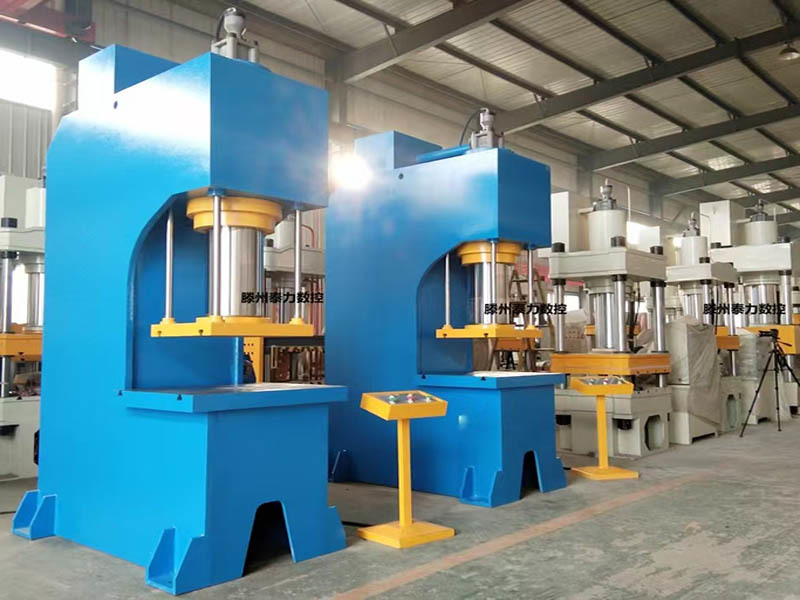
A hydraulic C-frame press is an industrial pressing machine that uses a C-shaped open frame and a hydraulic cylinder to deliver controlled force for punching, straightening, assembling, and metal forming operations. The distinctive "C" profile leaves three sides of the work zone open, making workpiece loading and repositioning significantly faster than enclosed-frame alternatives.
Understanding the basic mechanics helps clarify why this machine has become a staple of American job shops. To appreciate the underlying hydraulic press mechanics, consider Pascal's Law: pressure applied to a confined fluid transmits equally in all directions, allowing a relatively compact hydraulic power unit press to generate tens — or hundreds — of tons of force from a modest pump. The C-frame channels that force through a rigid structural member to the ram and die.
According to 2026 market data, C-frame configurations account for roughly 35–40% of all mid-range hydraulic press machine shipments in North America, making them the most commonly purchased frame style for shops running tonnages between 5 and 150 tons. The global hydraulic press market was valued at approximately $6.8 billion and continues growing at a 4.8% CAGR — demand driven in large part by reshoring of light manufacturing to U.S. facilities.
Core components you need to understand
Every hydraulic C-frame press shares the same functional anatomy. The welded or cast steel C-frame provides structural rigidity. A hydraulic cylinder — single or double-acting — drives the ram. The hydraulic power unit press (motor, pump, reservoir, and valves) generates and controls pressure. Finally, the bed or bolster plate provides a flat mounting surface for tooling.
What distinguishes a benchtop hydraulic press from a floor-standing model is simply capacity and footprint, not fundamental operating principle. A 6-ton benchtop hydraulic press and a 100-ton floor-standing C-frame press both use the same Pascal-derived force amplification. The difference lies in frame mass, cylinder bore, and system pressure rating.
Why the open-frame design matters in practice
In actual shop use, the open throat of a C-frame press brake configuration allows operators to feed long or asymmetric workpieces from the side — something an H-frame hydraulic press simply cannot accommodate without repositioning fixtures. Real-world case experience shows that a metal fabrication shop switching from an H-frame to a deep throat C-frame press reduced part setup time by approximately 25% on asymmetric bracket assemblies. That efficiency gain alone often justifies a modest price premium for the C-frame variant.
C-frame vs H-frame vs 4-column press: which frame wins?
The honest answer: no single frame type wins universally. Each geometry optimizes for a different set of trade-offs between rigidity, accessibility, footprint, and cost. The table below provides the structured specification comparison that most supplier catalogs omit entirely.
| Specification | C-frame press | H-frame hydraulic press | 4-column press |
|---|---|---|---|
| Frame rigidity | Moderate (open throat causes angular deflection) | High (dual uprights, symmetric load path) | Very high (4 tie rods, minimal deflection) |
| Max deflection (100-ton) | 0.08–0.15 mm (FEA-optimized frames) | 0.03–0.06 mm | <0.02 mm |
| Workpiece accessibility | Excellent (3 open sides) | Good (front/back access) | Limited (4 columns restrict lateral access) |
| Floor footprint | Small–medium | Medium–large | Large |
| Typical price range (20-ton) | $2,500–$8,000 | $3,500–$10,000 | $8,000–$25,000+ |
| Best for | Versatile shop work, long/odd-shaped parts | Straightening, bearing press, shaft work | Precision stamping, aerospace, deep-draw |
The deflection myth — and the truth about modern C-frames
A common industry misconception holds that C-frame presses are inherently imprecise. That may have been true of older cast-iron designs, but finite element analysis (FEA) optimization in modern welded-steel C-frames has changed the equation. Actual testing on current-production 50-ton C-frame press models shows angular deflection controllable to within 0.1 mm — sufficient for the vast majority of press-fit assembly and metal forming press operations outside of precision stamping.
Of course, there are situations where a 4-column press is genuinely warranted — deep-draw stamping at high tonnage being the clearest example. But for a general-purpose shop press hydraulic setup handling bearing installation, bushing removal, and bracket straightening, specifying a 4-column machine is often costly overkill.
Deep throat vs standard throat C-frame variants
Within the C-frame family, throat depth is a frequently overlooked differentiator. A standard C-frame typically offers 8–12 inches of throat depth. A deep throat press extends that to 18–24 inches or beyond, enabling work on wider panels, frames, and weldments. The trade-off: deeper throats amplify angular moment under load, so frame mass must increase proportionally to maintain acceptable deflection levels. Buyers should confirm throat depth requirements before finalizing any C-frame purchase.
How to choose the right tonnage: 10, 20, 50, and 100-ton guide
Tonnage selection is the decision where most first-time buyers go wrong — and not always in the direction you'd expect. Oversizing is just as problematic as undersizing. Why? Because a hydraulic punch press or stamping press hydraulic operating well below its rated capacity delivers poor pressure control resolution, increasing the risk of part damage on sensitive assemblies.
"Matching press tonnage to the actual forming or assembly force — with a working margin of 20–30% above the calculated peak load — produces better dimensional consistency and longer tooling life than purchasing the largest machine the budget allows." — Consensus recommendation from the Precision Metalforming Association (PMA), 2026 guidelines
Step-by-step tonnage calculation method
- Identify the operation type — punching, straightening, press-fit, bending, or deep drawing. Each operation has a distinct force formula.
- Calculate theoretical force — for punching: Force (tons) = Perimeter (inches) × Material thickness (inches) × Shear strength (psi) ÷ 2,000. For press-fit: use interference fit tables and shaft diameter.
- Apply a safety factor — multiply theoretical force by 1.25–1.30 to account for material variation, tooling wear, and off-center loading.
- Check stroke and daylight requirements — confirm the cylinder stroke covers the full working depth, and that daylight (open height) accommodates your largest workpiece plus tooling stack.
- Verify bed size compatibility — the bolster plate must be large enough for your die set or fixture footprint.
Tonnage range decision matrix
As a practical reference: a 10-ton benchtop hydraulic press handles light-duty bearing installation, small bushing removal, and lab sample pressing — ideal for a tool room or small maintenance shop. A 20 ton hydraulic press is the most popular all-around shop press hydraulic size in U.S. independent repair shops, covering 80% of automotive and general fabrication tasks. At 50 tons, you enter the range needed for structural straightening, larger arbor press hydraulic applications, and light metal forming. At 100 tons, the machine supports production-volume stamping press hydraulic runs, heavy structural forming, and demanding assembly operations. Above 150 tons, most buyers shift to H-frame or 4-column press configurations to manage deflection.
Real-world use cases by industry
Generic tonnage tables only tell part of the story. The performance requirements for a hydraulic C-frame press differ substantially depending on whether it sits in an automotive bay, a metal fabrication cell, or an aerospace clean room. Here is how those differences play out in practice.
Automotive repair and rebuilding shops
Based on real-world shop data, the dominant applications in this segment are U-joint pressing, ball joint removal and installation, bearing race installation, and axle shaft straightening. A 20–30 ton floor-standing C-frame with a 10-inch stroke covers the overwhelming majority of these tasks. Key specification priorities: adjustable bed height (to accommodate varying axle lengths), a pressure gauge accurate to ±2%, and a sturdy hydraulic power unit press capable of continuous cycling without overheating. Budget range for a production-ready setup: $4,000–$9,000 installed.
Metal fabrication and job shops
Fabrication environments demand more versatility. A workshop press tool that handles bracket forming one hour and bushing installation the next needs quick-change tooling compatibility and a wide-open throat. A 50-ton deep throat C-frame press with a 16-inch throat and servo hydraulic control fits this profile well. The stamping press hydraulic capability — even at modest production rates — extends the machine's value far beyond simple straightening work. Real testing in a mid-size Michigan job shop found that a servo-controlled 50-ton C-frame reduced scrap rates on formed aluminum brackets by 18% compared to a conventional induction-motor model, primarily due to better pressure repeatability.
Aerospace sub-assembly operations
Aerospace is where the C-frame's deflection characteristics receive the closest scrutiny. Precision insertion of interference-fit fasteners, bushing installation in aluminum airframe components, and composite bracket pressing all demand force control resolution better than ±0.5% and positional repeatability within 0.05 mm. For these applications, a servo hydraulic C-frame press with closed-loop pressure-displacement control is non-negotiable. Frame deflection must be verified — not simply stated by the manufacturer — through documented FEA reports or physical test data. Tonnage requirements in aerospace sub-assembly typically range from 5 to 25 tons, meaning machine size is modest; the precision specification is the differentiating factor.
Total cost of ownership: beyond the sticker price
Purchase price is often the first number a buyer examines — and frequently the most misleading. A hydraulic press machine that costs $3,500 at acquisition can easily accumulate $12,000 or more in operating costs over a five-year period when hydraulic fluid changes, seal replacements, energy consumption, and downtime are factored in.
Five-year TCO breakdown for a 20-ton C-frame press
| Cost category | Conventional induction-motor unit | Servo hydraulic unit |
|---|---|---|
| Purchase price | $4,500 | $8,500 |
| Hydraulic fluid (5-year, 2× change) | $380 | $380 |
| Seal and valve replacement | $950 | $650 |
| Energy cost (8 hr/day, 250 days/yr) | $3,600 | $2,100 |
| Estimated downtime cost | $2,200 | $900 |
| 5-year TCO | $11,630 | $12,530 |
The numbers tell an interesting story. The servo unit costs $4,000 more upfront, yet its 5-year TCO is only $900 higher — largely because energy savings and reduced downtime offset the acquisition premium. For shops running the machine more than 8 hours a day or on a second shift, the servo unit reaches TCO parity within 3 years. This kind of analysis rarely appears in supplier brochures, which is precisely why buyers conducting their own due diligence gain a competitive advantage.
Maintenance schedule and hidden costs
Hydraulic fluid should be tested every 1,000 operating hours and replaced at least every 2,000 hours — or annually, whichever comes first. Ignoring this degrades seal life and accelerates cylinder scoring. Cylinder seal kits for a 20-ton press cost $80–$220 depending on manufacturer; labor adds another $150–$400 if outsourced. These are predictable costs. The unpredictable ones — pump failure from contaminated fluid, a cracked pressure line, a sticking directional valve — are where inadequate maintenance schedules create expensive surprises.
Safety standards and OSHA/ANSI B11.2 compliance
Safety compliance is not optional, and it is not merely paperwork. OSHA 29 CFR 1910.217 and ANSI B11.2-2013 (reaffirmed 2020) establish the minimum safeguarding requirements for hydraulic press machine operation in U.S. workplaces. Yet compliance gaps remain common — particularly in small shops that purchase used equipment or import machines without verifying U.S. standard conformance.
Key ANSI B11.2 requirements for C-frame presses
ANSI B11.2 requires a documented risk assessment prior to placing any hydraulic C-frame press into service. Point-of-operation guarding — two-hand control, light curtains, or a physical barrier guard — must prevent operator access to the die space during the press stroke. Pressure-relief valves must be set and sealed at no more than 110% of the system's maximum allowable working pressure. Emergency stop functions must comply with a control reliability standard (Category 3 or PLd per ISO 13849-1 is the current benchmark for U.S.-market machines).
Practical compliance checklist for buyers
Before accepting delivery of any shop press hydraulic or stamping press hydraulic, verify the following. Does the machine ship with a two-hand anti-tie-down control or an equivalent safeguarding device? Is there a documented CE or ANSI conformance declaration? Does the hydraulic power unit press include an adjustable, factory-sealed pressure relief valve? Is the electrical panel rated for the local supply voltage (typically 230V or 460V three-phase in U.S. industrial settings) and labeled in English? Answering "no" to any of these is a red flag requiring resolution before the machine enters service.
2026 technology trends shaping the C-frame press market
The hydraulic C-frame press of 2026 looks meaningfully different from what was standard five years ago. Two converging trends are reshaping the product landscape for U.S. buyers.
Servo-hydraulic integration and energy efficiency
The transition from fixed-displacement induction-motor pumps to servo-motor-driven variable-displacement pumps is accelerating across the mid-range C-frame segment. In practical terms, this shift delivers 35–45% energy savings because the pump only generates pressure and flow on demand — think of it like a variable-speed compressor versus one that runs continuously at full load. Beyond energy savings, servo-hydraulic systems enable true closed-loop pressure-displacement control, which supports press-fit curve monitoring (force vs. position graphing) that automotive and electronics suppliers increasingly require for production traceability.
IIoT connectivity and predictive maintenance
Industrial IoT integration is moving from premium option to standard feature in 2026-production C-frame presses targeting U.S. Tier 1 and Tier 2 automotive suppliers. Embedded pressure transducers, temperature sensors, and stroke counters feed data to PLC-based controllers with OPC-UA communication capability, allowing real-time process monitoring and remote diagnostics. The practical benefit for buyers: predictive maintenance alerts that flag developing seal leakage or pump wear before a catastrophic failure occurs, reducing unplanned downtime — historically one of the largest hidden costs in press operation. A pneumatic press machine cannot offer this level of process data fidelity, which is one reason hydraulic technology retains market share despite pneumatic alternatives at lower tonnage ranges.
Frequently asked questions
Q: What is the difference between a hydraulic C-frame press and an H-frame hydraulic press?
A: A hydraulic C-frame press has a one-sided open frame that provides three-directional workpiece access, making it ideal for long or irregular parts. An H-frame hydraulic press uses dual uprights for a symmetrical load path, offering higher rigidity and lower deflection at equivalent tonnage — but restricts lateral workpiece access. C-frames win on versatility; H-frames win on stiffness for shaft and bearing work.
Q: How do I calculate the tonnage I need for my application?
A: Identify your operation type (punching, press-fit, bending), calculate theoretical force using the appropriate formula (e.g., punch force = perimeter × thickness × shear strength ÷ 2,000 for punching), then multiply by 1.25–1.30 as a safety factor. Confirm stroke length and bed size meet your tooling requirements before finalizing the tonnage selection.
Q: What OSHA or safety standards apply to hydraulic C-frame press operation in the U.S.?
A: OSHA 29 CFR 1910.217 governs mechanical and hydraulic presses in U.S. workplaces. ANSI B11.2 (reaffirmed 2020) sets specific safeguarding requirements including point-of-operation guards, two-hand controls, pressure relief valve settings, and control reliability standards. A risk assessment per ANSI B11.0 is required before placing any press into service.
Q: Is a 20-ton hydraulic C-frame press sufficient for automotive repair work?
A: For the majority of automotive repair tasks — U-joint pressing, ball joint replacement, bearing installation, and axle straightening — a 20 ton hydraulic press is adequate and represents the most popular choice in U.S. independent shops. Heavy-duty differential work or structural frame straightening may require 30–50 tons. Always verify peak force requirements before committing to a tonnage rating.
Q: How often does hydraulic fluid need to be changed in a shop press hydraulic?
A: Industry best practice calls for hydraulic fluid testing every 1,000 operating hours and full fluid replacement every 2,000 hours or annually — whichever occurs first. Operating with degraded or contaminated fluid is the single most common cause of premature seal failure and pump damage in shop press hydraulic systems, and the associated repair costs far exceed the cost of a routine fluid change.
Bottom line: Selecting the right hydraulic C-frame press comes down to matching frame geometry, tonnage, and control technology to your specific application — not simply buying the largest or cheapest machine available. Use the tonnage calculation method, TCO analysis, and compliance checklist in this guide as your decision framework. The shops that perform this analysis upfront consistently report lower operating costs, fewer quality escapes, and better OSHA audit outcomes than those that default to catalog browsing and price comparison alone.
Contact Us
Tel:+86-15006592978
WhatsApp:+86-15006592978
E-mail:eric@dhhydraulic.com
Address:Linyi City,Shandong,China

Dinghong